Safety-Critical Control for Smoothed Implicit Contact Dynamics

arXiv 2026

Anonymous Authors
Anonymous Affiliation
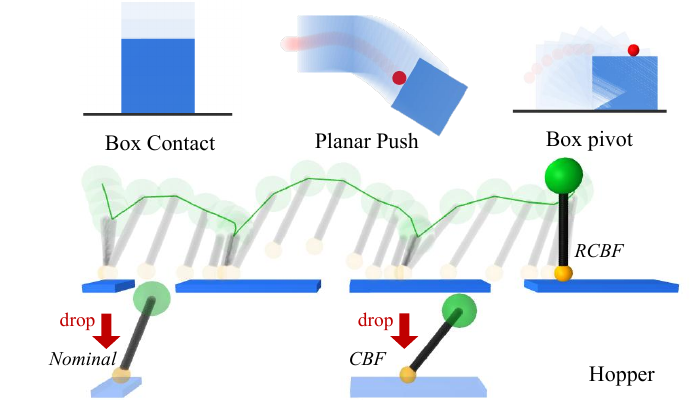
Four contact-force safety examples: box contact, planar push, box pivot, and hopper

We enable CBF-based safety filtering for implicit contact dynamics through local affine contact-force prediction and robust tightening against approximation error.

Abstract

Smoothed implicit contact dynamics enables gradient-based planning and control for contact-rich tasks without predefined mode sequences. However, safety-critical control remains challenging because implicit contact dynamics makes safety-filter design nontrivial. The smoothing parameter κ relaxes contact complementarity constraints, which makes the dynamics smooth but affects the contact force. This paper provides a safety-filtering framework for smoothed implicit contact dynamics. We first derive a discrete-time control barrier function (CBF) constraint using a first-order Taylor approximation of the implicitly defined contact force. We show that, although reducing κ can improve local force-approximation accuracy, the resulting closed-loop force-constraint violations can vary non-monotonically with κ. Motivated by this observation, we introduce boundary-focused rollouts that screen candidate κ values by comparing the predicted safety margin with the observed one-step under-prediction. We then robustly tighten the predicted CBF constraint with a fixed margin to account for residual force under-prediction. Simulations on four contact-rich systems show that the proposed method eliminates force violations observed under a standard CBF.

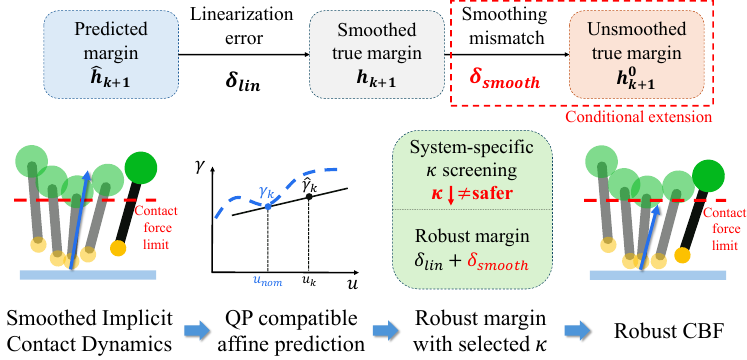
The proposed robust CBF framework for smoothed implicit contact dynamics
A local affine prediction makes the implicit contact model QP-compatible; κ screening and a robust margin address linearization error, with a conditional extension to unsmoothed dynamics.

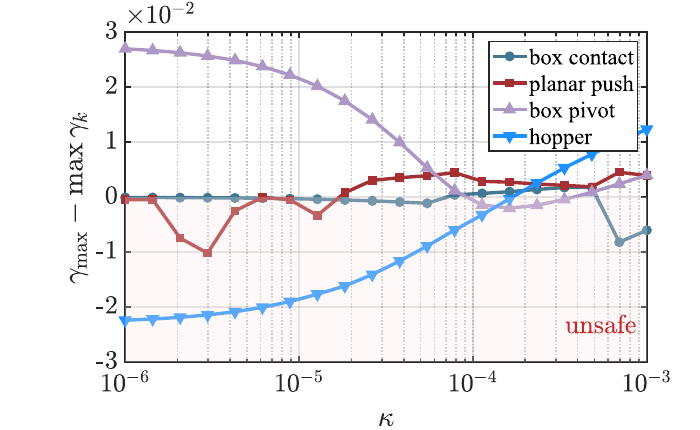
Smaller κ is not necessarily safer.

Smoothing changes both the local approximation error and the closed-loop contact response.

Kappa sweep results across four contact-rich systems
κ-sweep results across four systems. The shaded area marks the unsafe region.

Boundary-focused κ screening

Candidate κ values are evaluated on the same short-horizon rollouts near the safety boundary. The screening score compares the lower-tail predicted safety margin with the upper-tail one-step under-prediction.

This selects a task-compatible smoothing value for the calibrated operating region instead of treating κ as a purely numerical parameter.

ĥk+1(uk; κ) ≥ (1 − α)hk + δκ

Robust contact-force safety

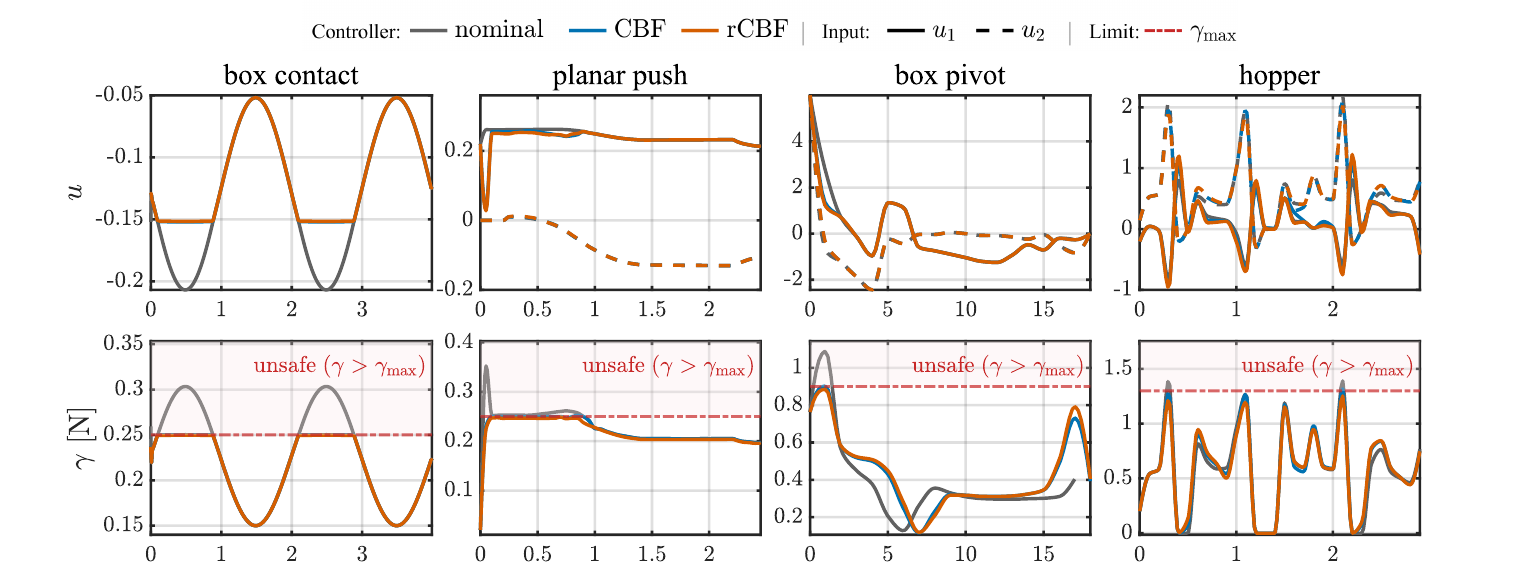
The robust CBF removes the residual force-limit violations caused by local prediction error.

Control inputs and contact forces for box contact, planar push, box pivot, and hopper systems
Nominal (gray), standard CBF (blue), and robust CBF (orange) over four systems. Red lines and shading denote force limits and unsafe regions. In the reported rollouts, the robust CBF produces zero observed violations.

0

observed rCBF violations

4

contact-rich systems evaluated

QP

compatible online safety filter

Additional simulation comparisons

Qualitative standard-CBF and robust-CBF comparisons on two robotic systems.

Panda — Fragile Plate Edge Pivot

Unsafe contact events are highlighted in red when the pusher force, touchdown impulse, or sustained edge load exceeds its physical limit. Yellow markers indicate contacts operating near the limit, while red force arrows and double rings reveal violations as they occur.

Go2 — Safe Landing on Fragile Terrain

Unsafe landings are identified from foot-wise touchdown impulse, sustained contact force, and terrain-relative body tilt. Yellow markers indicate near-limit contacts, while red force arrows and expanding rings highlight physical-limit crossings during touchdown or sustained loading.

BibTeX